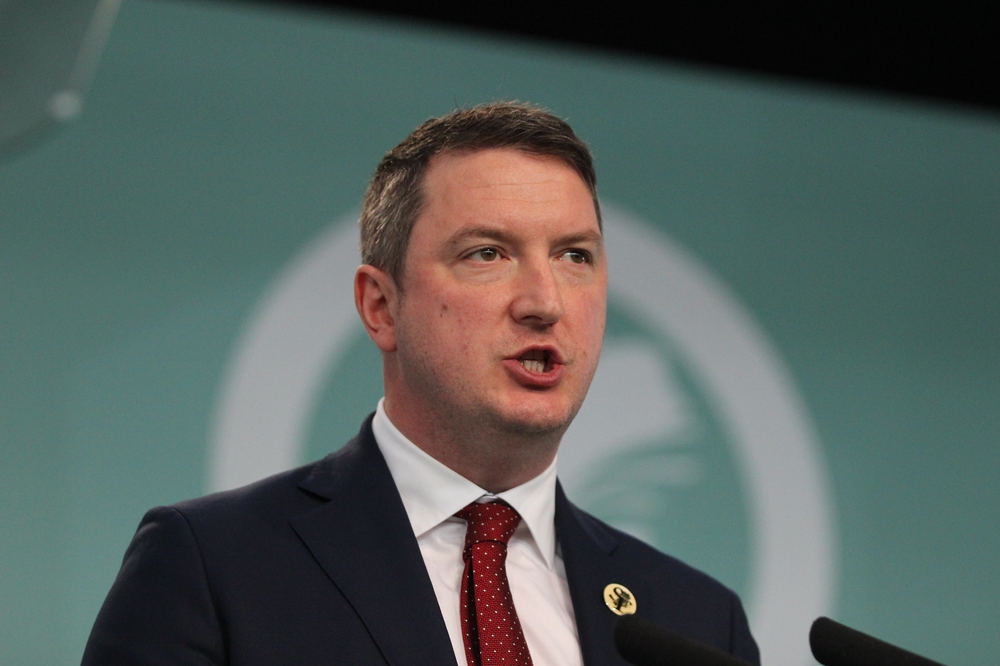
Pat Cullen was elected as MP for Fermanagh South Tyrone in July 2024. She is the youngest of seven children and grew up in Co Tyrone. She is married with two children, and recently became a grandmother. Pat holds a degree in Nursing and a Master’s in management and qualified as a registered nurse in 1985 working in a range of community and clinical healthcare settings, before becoming a director of nursing. She has held senior roles within nursing, including Director of Nursing at the Public Health Agency and advisor to the Department of Health, before joining the Royal College of Nursing in 2016 and became the director of the College in NI in 2019. Pat is an honorary professor of Queen’s University.
What is your earliest political memory?
My earliest political memory is the time of the blanket protest and then the no-wash protest. Whilst I was very young, I remember this so well. Every night, our mother brought us together for the rosary and she offered the first decade for the men on the blanket and the women in Armagh. The second decade was ‘to banish’ the British army from our shores and to keep us safe from their hands. I remember her very words and the significance of her prayers. I also knew the families around our townland and throughout Carrickmore that were suffering as a result of British rule and the impact it was having. I also remember the impact of our home being constantly searched and destroyed for no reason and the unjustness of this invasion of our rights and privacy.
What is the biggest change you have seen in your lifetime?
The biggest change, without question was the announcement of the Good Friday Agreement. I will never forget the 10 April 1998. My husband and I had taken the children away for the weekend to Ennis. It was my husband’s birthday. The children were eight and three and they kept wanting us to build a snowman with them as it had snowed the previous night. They kept asking why we were watching the TV and crying. We knew their lives were going to be so different to ours. Both of us worked in the health service and seen first hand the impact of the conflict on everyone we treated and just knowing that change was ahead of us was unfathomable. I will never forget that day.
Are you encouraged by the conversation on constitutional change?
I am encouraged to see key figures from a range of backgrounds, be it the arts, business, health, trade unionism and many others engaging in constitutional conversations. People like the Rev Karen, James Nesbitt, Mick Lynch and many others who truly wish to see their communities represented, engaged and included. This is a great start but must be strengthened. Space must be made for others to join the conversations. As well as civic leaders taking the lead, we need to see greater leadership from politicians who will find this a challenging space to enter but enter they must. They must make sure that a New and United Ireland is designed to equally reflect the people they represent, their cultures, traditions and economic aspirations, so they can flourish in the years ahead.
Is Irish Unity a realisable goal and when?
Personally, I believe Irish Unity is inevitable. Every aspect of life will be enriched through a unified Ireland. I can speak about the NHS and the importance of unified health and care services for the future of the NHS in the North. Improving healthcare clinical outcomes and managing healthcare costs are dependant on economies of scale. We will only truly address the NHS challenges we have by expanding North/South healthcare services. I was very fortunate to be part of the commissioning team leading the development and commissioning of Island wide Paediatric cardiac surgery services and radiology services across Derry and Donegal. I saw first-hand the marked increase in clinical outcomes for patients as well as the improvements in patient experience. There’s so much more to do in this area alone.
What advice would you give to those advocating for a united Ireland?
My advice is to make sure we never repeat the mistakes the British government made with Brexit. Always be honest with the people. Planning and preparation is key. People must be taken on a journey – a journey of inclusive dialogue with a place at the table for all voices to be heard, no matter how diverse or difficult these conversations may be. Irish people pride themselves on leaving no one behind, so I would say let’s build on our commitment to equity and equality.
What role must the Irish government play in planning for the future?
The Irish government must start preparing the ground work for referendums. It must be a key public policy priority for the next Irish government. I would expect to see the commitment set out in all party manifestos. The next Irish government must commence immediate work by developing a detailed Green paper that lays out the framework for holding a unity referendum. The framework needs to recognise the need for establishing an All-Island citizens Assembly and establishing a dedicated government department that is properly resourced to progress the work at pace.
Do you support the establishment of a Citizens’ Assembly/Assemblies?
I have experience of a number of citizen type Assemblies and wholeheartedly support an All-Island Citizens Assembly. It is important that such an Assembly comprises citizens and expert witnesses and is properly resourced with adequate facilitators and organisers. A citizens Assembly allows for open discussion and dialogue and for focussed questioning. It is only through a Citizens Assembly that recommendations can be made by citizens based on evidence and expert engagement.
If you could look 10 years into the future what would you hope to see?
I would like to see us using the next years preparing the groundwork for referendums and that we see these held within the next 5-6 years. In 10 years’ time, I believe I will be living in a new and united Ireland that is a better place for everyone, in charge of our own decisions for everyone that calls the Island their home. I yearn for the day we are no longer depending on a British government who has no interest in the prosperity of our people. I bear the scars of trying to negotiate with a British government for a fair pay deal for frontline nurses and witnessed on a daily basis their lack of interest, compassion or respect for working class people. I hope the future is one where we never again have to go begging to a British government for the crumbs of their table.

This interview first appeared in issue 81 of Éire Nua – you can download the original right here.