The British Labour Party met in Liverpool this year for its annual party conference. In July the Labour Party moved from the opposition to government benches. Therefore, for the first time in fifteen years, the Labour conference was addressed by sitting British Cabinet Ministers.
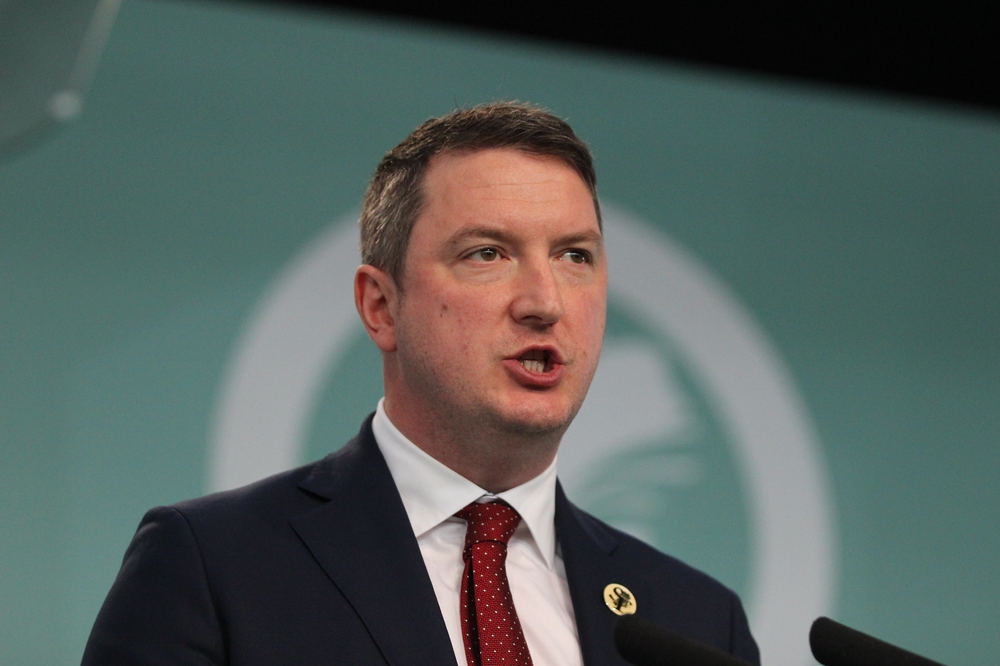
On the first evening of the conference, Sinn Féin hosted its annual fringe meeting in the Adelphi Hotel, Liverpool. Marking a change from previous year’s fringes, there was no top-table panel discussion. Instead, the evening saw an opening keynote address by Uachtarán Shinn Féin Mary Lou McDonald TD. This was followed by a an ‘in conversation…’ interview with the journalist and broadcaster Andrea Catherwood.
The meeting was well-attended, with over one-hundred people seated. The assembled audience included sitting Members of Parliament, former-Members of Parliament, Labour Party councillors, conference delegates, trade unionists, and members of the local Liverpool-Irish community.
The Sinn Féin President used the occasion to press for a genuine transformation of British-Irish relations, going way beyond a mere ‘reset’ back to the status quo. Emphasising the need for future constitutional change, the Sinn Féin leader spelt out, in practical terms, precisely what steps a Sinn Féin led government in Dublin would take to advance the cause of Irish unification. The address, and subsequent interview , was well-received and generated notable headlines across Ireland and Britain.
For the interest of our readers, we include an edited version of Mary Lou McDonald’s address to the Sinn Féin fringe meeting:
Friends,
Earlier this year Michelle O’Neill made history when she was elected First Minister of the Northern Executive, the first nationalist to ever hold this post, in a place designed to ensure that this could never happen. The political landscape was to change once again in July when Sinn Féin emerged as the largest party in the Westminster elections, confirming the change underway in Ireland.
At a time of such change, it is both timely and necessary to step up the conversation about the future of Ireland, about how we confidently manage constitutional change, and build the momentum for the achievement of Irish Unity in our time.
This is an important moment in advancing this journey. Ireland’s future will be determined by choices made today, by decisions of this generation. The future will be defined by how we rise to the challenges and how we seize the opportunities. We must demonstrate the determination and the ambition to bend the arc of history towards reunification, ending partition.
Transforming British-Irish relations
The relationship between Ireland and Britain is a complex one. A relationship shaped by colonisation, oppression, occupation, conflict. Thankfully now changed by a transformative peace that once seemed unimaginable.
A relationship where emigration and the search for work formed connections between people over generations tying together real bonds of friendship and family.
The achievement of the Good Friday Agreement was a watershed in our political relationship. Driven by a shared hope for a peaceful future, the agreement forged a new dynamic and a partnership anchored by respect and cooperation.
Both the British and Irish governments have a responsibility to work together for the good of the people as co-guarantors of peace, reconciliation and the realisation of a new future.
It is by working in the spirit of friendship that we will together write a new and successful chapter in British-Irish relations.
A mature conversation on constitutional change
Part of this new chapter must be the realisation that constitutional change in Ireland is coming. I am very aware that this is the subject of genuine conviction and opinions right across Irish society. It also stirs deep emotions for people.
We need a mature and respectful conversation aboutconstitutional change. It’s a conversation that should be approached with optimism, ambition and a real sense of opportunity. The conversation must be inclusive. It must recognise that people hold different and competing views about the future.
I am the leader of Sinn Féin. I am an Irish republican. I see a United Ireland as the very best, most exciting prospect for the future, for nationalists, unionists and everyone else on our small island. The reunification of Ireland presents the single greatest opportunity to unlock the potential of our island, to deliver prosperity for all.
We are living in a time when history will be made by the people. That is why referendums on Irish unity should be held by the end of this decade to allow the people to have their say. The moment will come to name the date but first the British government must make clear its intention to trigger referendum as per the Good Friday Agreement and set out the threshold for the referendum as they see it. No more dodging. Clear honest conversations.
Our countries are each other’s nearest neighbourhoods, and good neighbours always want what is best for each other. What is best for Ireland is that Britain ends its involvement in our affairs, and that the people of Ireland finally get to decide our future together.
I believe that is what is best for Britain too. In this democratic conversation, I see every single person who argues for the preservation of the Union with Britain and their British identity as an equal, no caveats or exceptions. Equal.
The New Ireland we seek to build belongs every bit as much to the families of the Shankill as it does to the families of the Falls. Every bit as much to the families of Fermanagh as the families of Dublin, Cork and Galway.
Whether you argue for Irish reunification or for the preservation of the union, the nature and quality of the conversation matters. We must listen to each other, engage with the facts, and resist the urge to be driven by fear or misinformation as witnesses during Brexit. Let us commit to a conversation that is thoughtful, measured, and above all, respectful.
This dialogue must transcend party politics and focus on what is best for all citizens. We must create spaces where all voices are heard and where no perspective is dismissed out of hand.
Ultimately, it is the people who will decide their future as provided for in the Good Friday Agreement. But it is our responsibility to ensure that this decision is made through an informed and respectful process between both the new Labour Government and the next Irish Government.
If Sinn Féin is given the chance to lead the next government, we will advance this conversation. In government, we will make the reunification of Ireland and its people a key priority.
We will take the following practical steps:
• Establish a Reunification and One Ireland unit within the Department of An Taoiseach.
• Appoint a Minister of State for reunification and One Ireland.
• Produce a Government ‘Green Paper’ in the first 100 days setting out our vision for a New Ireland.
• Establish a joint Oireachtas Committee on reunification and future constitutional change.
• Begin the necessary planning and preparation by establishing a Citizens’ Assembly on our constitutional future.
• We will give MPs from the North of Ireland speaking rights in the Oireachtas.
• And we will commence planning and actively work towards the holding of referendums on Irish Unity by the end of this decade.
Friends. Generational change is happening in Ireland, and what we do now is what counts. A new and united Ireland and is about everyone. A new and united Ireland is for everyone.