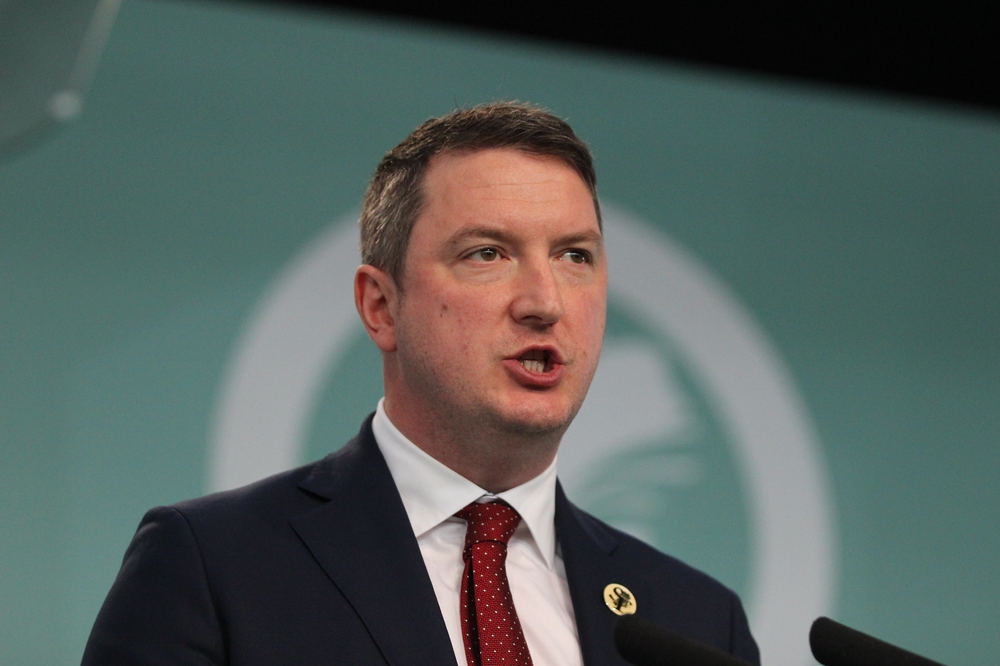
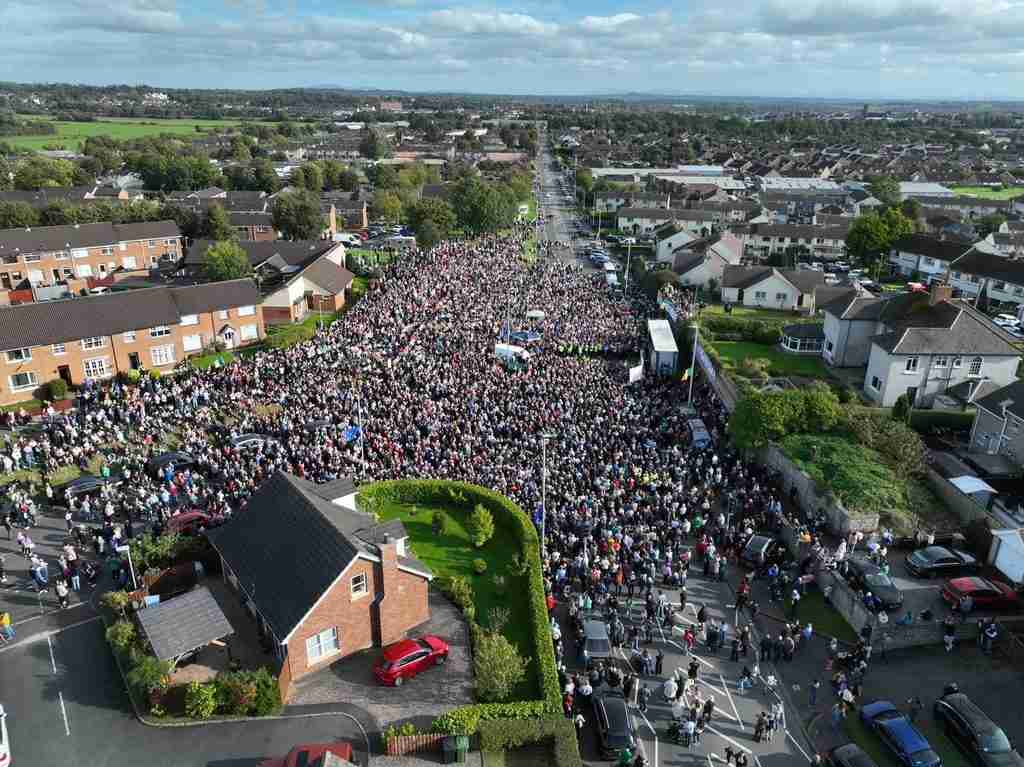
Leas-Uachtarán Shinn Féin Michelle O’Neill addressed the 45th National Hunger Strike Commemoration in Ballina, Co. Mayo on Sunday.
Ms O’Neill said Hunger Strikers of 1981 did not simply give their lives in resistance; they helped awaken a national confidence that continues to grow with each new generation.
She said: “Forty-five years after the Hunger Strike, the greatest tribute we can pay to those we honour today is not simply to remember them. It is to continue building the future they knew was possible.”
She continued: “Let us honour all those we remember today by helping to build that future. Let us continue our journey with confidence and determination. Let us build a new, united Ireland.”
Michelle O’Neill’s address in full:
A chairde,
Is mór an onóir dom bheith libh anseo i mBéal an Átha inniu.
It is a great privilege to be with you all in Ballina to remember and honour the unbreakable spirit of our brave Hunger Strikers.
Today, we gather to remember, to honour, and to renew our commitment to the ideals for which so many Irish republicans gave everything.
This year marks the 45th anniversary of the 1981 Hunger Strike, one of the most significant events in modern Irish history.
An trom. Am ar leith. Am suntasach.
It was an event that helped shape our struggle and for many people here today those months in 1981 defined and inspired a life-long commitment to the cause of Irish freedom and unity.
Forty-five years ago, ten brave Irish republicans laid down their lives in the H-Blocks of Long Kesh.
Bobby Sands.
Francis Hughes.
Raymond McCreesh.
Patsy O’Hara.
Joe McDonnell.
Martin Hurson.
Kevin Lynch.
Kieran Doherty.
Thomas McElwee.
Mickey Devine.
Today we remember them with love, gratitude and immense respect.
We remember also their families, whose immense pain and suffering did not end with the funerals, but who have carried that loss with extraordinary courage and dignity ever since.
Tá sibh inár gcroíthe.
Only a few weeks ago we learned the sad news of the passing of Brendan Hurson, brother of Martin Hurson. Brendan was a gentleman, a proud brother, who kept the memory of Martin’s sacrifice alive after all these years. Fear uasal a bhí ann.

I want, on behalf of all of us here today, to send our deepest sympathy and solidarity to the Hurson family at the immense loss of Brendan.
Here in Mayo, we also pay special tribute to three of this county’s own sons – Michael Gaughan, Frank Stagg and Seán “Jack” McNeela.
The deaths of Michael Gaughan in 1974 and Frank Stagg 50 years ago in 1976 came before the H-Block Hunger Strike.
Their courage and steadfast commitment inspired a new generation of republicans who would themselves face extraordinary challenges.
Spreag siad ansin muid. Spreagann siad fós muid.
Jack McNeela died on hunger strike in 1940, in an earlier chapter of Ireland’s long struggle for independence.
The cause for which he gave his life, and the method of resistance he was forced to choose, were the same then as in 1981.
Today we honour all of them with equal pride, admiration and respect.
The 1981 Hunger Strike was about much more than prison conditions.
It was about dignity.
It was about political principle.
It was about resisting the attempt to criminalise and to delegitimise the struggle of the Irish people for freedom and justice.
Republican prisoners rejected all attempts by Britain and its apologists to claim they were not political prisoners.
Criminalisation was a British political strategy designed to undermine the Irish republican struggle by targeting isolated, vulnerable and often very young prisoners, locking them up in isolation in a new part of the notorious Long Kesh prison camp.
The name of that new prison complex, the H-Blocks of Long Kesh would soon become known across the world as a place of terrible brutality and suffering.
The H-Blocks were well named – as a protest chant of the time pointed out – it was ‘H’ for Hunger and ‘H’ for Hell.
The prison struggle was not fought by men alone.
In Armagh Women’s Prison, republican women resisted criminalisation with extraordinary courage.
They endured the 1980 Hunger Strike, the no-wash protest, strip searching, and immense hardship, standing shoulder to shoulder with the prisoners in the H-Blocks in defence of the republican struggle, of their political status and their human dignity.
The contribution of the Armagh Women was resolute and indispensable.
History has vindicated the stand of the Irish republican political prisoners in the H-Blocks, in Armagh and in countless other prisons across the globe and across decades and centuries of resistance – these prisoners were part of an unbroken chain of defiance and resistance to British rule.
The British Government could imprison men and women, but they could never imprison the ideals for which they stood.
As Bobby Sands wrote: “They have nothing in their whole imperial arsenal that can break the spirit of one Irishman who doesn’t want to be broken.”
Their spirit and courage inspired millions and continues to inspire people across Ireland and across the world.
The election of Bobby Sands as MP for Fermanagh/South Tyrone, followed by the election of Kieran Doherty as TD for Cavan/Monaghan and Paddy Agnew as TD for Louth, demonstrated beyond doubt that, despite Britain’s enormous propaganda machine, the Irish people rejected Britain’s criminalisation strategy.
Those elections transformed Irish politics and opened a new chapter in our national struggle that has led to enormous positive and progressive change in Irish society.
When we look at the North today, we see changes that many believed were impossible.
Fleadh Cheoil na hÉireann in Béal Feirste was the biggest Fleadh ever seen in this country.
The Fleadh attracted an attendance of over 1.6 million visitors in a celebration of Irish culture that would never have been possible in Belfast previously.
Cathair lán cultúr, ceol agus craic – Cathair bhródúil.
Many people expressed to me how the Fleadh had moved them emotionally because Belfast now is a far, far distant place from the oppressive, sectarian, bastion of discrimination that was the Belfast that so many of them grew up in.
It’s difficult to believe now but it was only in August 1993, after decades of exclusion, that the first Irish republican march was allowed to reach Belfast City Hall, for so long the sole preserve of Unionism.
1993 – And look how far we have come since then.
Belfast city centre was a no-go area for Irish nationalism and Irish cultural expression and identity.
Every year up to 1993, nationalist marches were banned from Belfast city centre and physically locked into West Belfast by lines of armoured cars, armed RUC riot squads and the British Army.
Tragically, after the 1993 march successfully reached Belfast City Hall for the first time, a loyalist death squad that evening attacked the family home of Sinn Féin councillor, Bobby Lavery, killing his young son, Sean.
The success of the Irish peace process in transforming society means we can look forward with optimism and confidence.
The emotion that I witnessed and felt myself so deeply during the Fleadh reflects that transformation.
We saw a generation of young people who are confident in themselves, proud of their Irish identity, their language, their culture.
That same confidence is growing across the South.
A new generation is comfortable in its Irishness, educated, outward-looking and deeply rooted in its own history and culture.
Free from the insecurities and lack of opportunity that too often held previous generations back, they are ambitious for themselves and for their country.
Ireland is in transition.
Unfortunately, there are those, including the Taoiseach, Micheál Martin, who would rather avoid the responsibility of leadership that is needed to prepare for properly planned constitutional change.
Leadership means engaging, listening and preparing.
As republicans, we seek unity not simply as a constitutional objective but as the opportunity to build a better Ireland – one where families can afford a home, healthcare is available when needed, work is fairly rewarded, rural and urban communities thrive, and every citizen is treated with dignity.
As James Connolly taught us, the struggle for Irish unity and the struggle for social justice are inseparable.
National freedom has meaning only if it improves the lives of ordinary people.
A united Ireland must belong to everyone who shares this island, including those who cherish a British identity.
The future we seek asks nobody to surrender who they are.
Instead, it invites everyone to help shape what we can become together.
Without doubt, the north of Ireland has been fundamentally changed.
The orange state is gone.
Majority support for the union with Britain is gone.
But there is still much work to be done.
The recent comments of the new British Prime Minister that a border poll is off the table were divisive, arrogant, and ill-informed.
The right to a referendum on Irish Unity is a key part of the Good Friday Agreement.
A unity referendum is not a concession to be gifted to the people of Ireland by any English politician.
In the Assembly and Council elections next May, the people of the north can elect the biggest ever Sinn Féin team and send a clear and strong message to the British Government that change is happening, that change is unstoppable, that the future won’t be dictated to the people of Ireland by English politicians who receive no votes here and have no support here.
The future of Ireland is for the people of Ireland alone to decide.
In the Assembly, there is deep frustration at the ongoing obstruction and unnecessary deadlock that too often prevents the Assembly delivering for the people.
Politics should improve people’s lives but time and time again we see the mechanisms that were designed to protect rights and equality being misused by the DUP and wider unionism to block progressive change and to delay and obstruct delivery.
Unionist parties are putting ever more fingers in the dam to try to stop progress.
They can try, but ultimately here’s the thing, they will fail to stop progress and to stop a new and better future for all our people.
Despite the deep frustration, the obstruction, and the anti-Irish sectarianism, Sinn Féin will not be deterred.
Let me say very clearly.
Sinn Féin is not walking away.
Walking away would mean handing control of our public services over to British Government ministers.
That would be disastrous and Sinn Féin is not going to do that.
So, despite the challenges of being in an executive with people who are fundamentally opposed to power-sharing, to rights and to equality, Sinn Féin will continue to do all we can to move forward, to overcome the obstruction and deliver for people in the here and now.
We are also very clear – the only way to fully deliver rights, equality, respect and inclusion is through a new and a united Ireland. Every sectarian, partisan or divisive action taken by the DUP, calculated to provoke and annoy, actually becomes another argument for Irish unity.
Every attempt to block the Irish language and culture, every veto exercised on rights and equality, every obstruction and delay is further evidence of the need for a new and united Ireland.
We have witnessed another attempt this week by unionist leaders to bring us back to the past.
To attempt to reignite the closed issue of trying to force a parade down Garvaghy Road.
Sinn Féin stands fully with the people of Garvaghy Road.
The people of Garvaghy Road have lived peacefully for 28 years and they deserve to continue doing so. Nobody should seek to reopen wounds which have still not fully healed.
The sectarianism and the violence visited upon the Garvaghy Road community cannot and will not be allowed to happen again. This community should not be forced to live under a cloud of fear or intimidation. The Garvaghy Road residents deserve to live in peace.
And Sinn Féin will stand with them every step of the way.
Despite the desperate attempts by unionism to slow down and frustrate progress, Sinn Féin is looking to the future with confidence – Irish unity is now within touching distance.
Majority support for the union with Britain is gone.
We are in this position in our long struggle for freedom and unity because of the courage and sacrifice of those who refused to give in or give up, who endured discrimination, imprisonment and hardship, and because of those who made the ultimate sacrifice.
Their courage inspires us every day.
The Hunger Strikers of 1981 did not simply give their lives in resistance; they helped awaken a national confidence that continues to grow with each new generation.
That is their living legacy.
Every generation faces its own challenges.
Those we honour today answered history with extraordinary courage.
Our responsibility is different – to utilise the pathway provided by the Good Friday Agreement to build support for Irish unity.
Ní neart go cur le chéile, a chairde – there is no strength without unity.
Our task is to organise. To prepare. To persuade. To build support. And to ensure that Irish unity delivers a better future for everyone.
There was a time when many tried to dismiss Irish unity.
Even through to today.
Yet it is the defining political conversation on this island.
Forty-five years after the Hunger Strike, the greatest tribute we can pay to those we honour today is not simply to remember them. It is to continue building the future they knew was possible.
Through preparation. Through persuasion. Through hard work and patient organisation. Through reaching out to those who may not yet agree with us.
A chairde,
Events such as today’s matter deeply. They remind us where we have come from, the price that has been paid, and the responsibility we owe to those who will come after us. Today we remember the ten men who died on hunger strike in 1981. We remember Michael Gaughan, we remember Frank Stagg on his 50th anniversary, and we remember Jack McNeela. Cuimhnímis orthu siúd uilig a chuaigh romhainn.
And we remember all those Irish patriots who endured imprisonment, suffering and sacrifice. We honour them best by completing the journey towards the Republic they knew was possible.
As previous Leas-Uachtarán of Sinn Féin, Máire Drumm said: “We must take no steps backward; our steps must be onward.
“For if we don’t, the martyrs that died for you, for me, for this country will haunt us forever.”
So onwards we go.
To a united Ireland. A free Ireland. Éire aontaithe agus saor.
An Ireland founded on equality and social justice.
That future is within our reach.
Bobby Sands never lost sight of the future, even in the darkest of circumstances.
He reminded us: “Our revenge will be the laughter of our children.”
Let us honour all those we remember today by helping to build that future. Let us continue our journey with confidence and determination.
Let us build a new, united Ireland.
Ar aghaidh linn le chéile.
Go raibh míle maith agaibh.