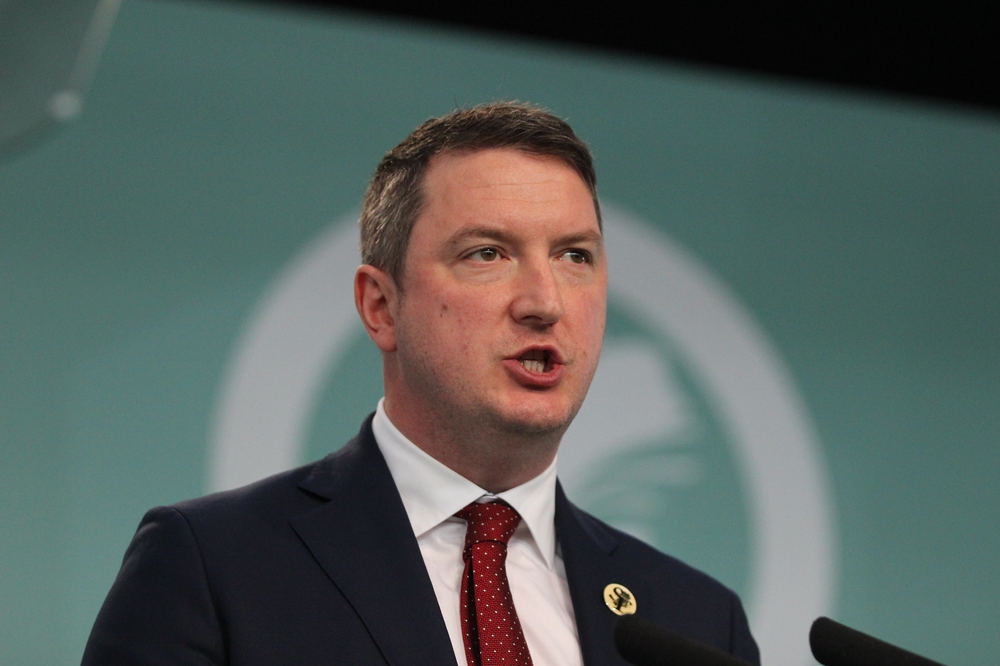
Diane Abbott MP was in Belfast in August to address the annual Féile an Phobail. The former Shadow Home Secretary sits today as the ‘Mother of the House’ in the Westminster Parliament, having been returned to serve the people of Hackney North and Stoke Newington on ten occasions.
As she travelled to Belfast, she was joined by Joe Dwyer of Sinn Féin’s London Office who sat down with the veteran Labour politician to reflect on her years of political activism and long-standing support for the cause of Irish unity.
Joe Dwyer: Obviously, many Irish emigrants and many West Indians in the 1950s settled in West London; you grew-up in Paddington, which at that time was a melting pot of many of these newly arrived communities. This was also a time of hostility, suspicion, and outright racism – we cannot forget that “No Blacks, No Dogs, No Irish” was a common enough sign in the windows of lodgings. Do you think that growing up in such a climate had a formative effect on your later politics?

Diane Abbott: I think we are all a product of our environment. The area in Paddington was almost unique at that time in being such a mix of white West Londoners who were still recovering from World War II, the long-established Irish communities were really on the fringes of Kilburn and then the newer arrivals as part of the Windrush Generation. Obviously, Paddington is quite a way from the docks or the coast and what first attracted people from the Caribbean was that landlords would actually take them in, even if the accommodation was sometimes very expensive, small, and poor quality. It was quite an interesting environment because alongside poverty and discrimination there was also solidarity and possibility. But that became a shared experience of those communities, and it certainly seems to produce its share of radicals. Both Mick Lynch and Mick Whelan, who are the general secretaries of the two main rail unions in Britain grew up in Paddington. One of the London branch trade union banners is dedicated to Jim Larkin, so the connection is never forgotten.
Joe Dwyer: By the time you’re a young adult and you’re becoming further politicised – Ireland was increasingly in the headlines and news bulletins. In 1973, you attend Newham College, Cambridge, to study history. It would have been very easy for a young black woman living in Britain to stay quiet when it came to Ireland as an issue. As a young black woman living in Britain, you already had plenty of your own battles to contend with – many people with closer ties to Ireland decided to keep their heads down. Why did you think it was important to take a stand on issues like Ireland?
Diane Abbott: For me, the question of Ireland is a question of democracy. No colony is ever a democracy because no-one ever chooses to be invaded, as the whole of Ireland was by Britain. I have always hated injustice and then later I became a socialist. Originally, us socialists were called social democrats because we want democracy throughout the whole of society. That includes national democracy in the form of freedom for the colonies.
In the 1970s there was this terrible conflict and events that echoed around the world, such as Bloody Sunday. I felt that I had to try to understand this conflict which included, among other things, British soldiers shooting unarmed civilians on the street. And I was not alone. A small minority emerged in Britain who questioned or opposed Britain’s role in Ireland. Now, of course, the issue of democracy is front and centre. There is a pathway to a United Ireland if the people of Northern Ireland decide that is their will.
Joe Dwyer: As the decade progressed, you found yourself working at the National Council for Civil Liberties. This was a time of the Prevention of Terrorism Act and multiple miscarriages of justice; the Guilford Four, Birmingham Six and so on. Quite memorably, Gerry Adams visited Brixton in the early 1980s, and compared how similar it was for the working-class of Brixton and the working-class of Belfast – you had communities that were first criminalised, and then consequently over-policed, and then you get a vicious circle that embeds itself quite stubbornly. We see it today with the vilification of the Muslim community. What lessons are there to be learnt from that time, in terms of fighting back and standing up for marginalised communities and their rights, often against the State itself?
Diane Abbott: I think we have to accept that Britain frequently adjusts to change but it does so in a wrenching way. History tells us there were ‘race riots’ in Notting Hill in the 1950s and 1960s. That is not really true. They were attempted pogroms to drive out Caribbean people from the area. My family, and specifically me, were saved from one by my Irish ‘Uncle Jimmy’ who lived in the flat downstairs. They turned to extreme violence just because some of their neighbours were now Black. When Thatcher launched her attack on society and her attacks on young people in particular, there were riots in most of the major English cities. What we saw was a conscious re-import of pervasive and brutal policing techniques that had been imposed on the Irish then being used on British youth and later in strikes like the miners’ strike.
In that sense, Ireland has often been used a testing-ground for what the armed parts of the state can do in Britain. The idea that you can police your way out of these upheavals is false, but that is the stock response. It is a police mentality. But history shows that political solutions are required.
Joe Dwyer: You were politically close to Ken Livingstone, as I understand it you worked for a time as a press officer at the GLC, and this would have all been at a time when Ken was attacked for daring to even speak with representatives of Sinn Féin. Yet, time would prove that dialogue was key to finding a pathway to peace. Today, we see daily atrocities in Gaza and the West Bank at the hands of the Israeli Defence Forces. Israel is showing itself to be unwilling to engage in dialogue, what hope is there? Is such dialogue inevitable? Essentially, what does it take to unlock such intractable conflict?
Diane Abbott: Well Ken was right on Ireland, as he was right on so much else. We were called the “loony left” for talking to Sinn Féin, for advocating women’s rights, for Black people’s rights as citizens, and for saying that lesbians and gays should not be discriminated against. But we were right. Anyone who genuinely wants peace will know that you have to talk to all the representatives of the Palestinian people and address all the injustices against them. Everything else is just play-acting, fake concern because politicians know how unpopular the Israeli carnage is. And you have to address all the justified grievances, otherwise new forces will arise to express those grievances. This has actually been the history of all those who tried to deny Palestinian rights. There is only one alternative to broad, comprehensive peace talks, which is Netanyahu’s policy of genocide. He wants to eliminate the problem by eliminating the Palestinians. It is one of the greatest scandals of my lifetime that Western governments have allowed this to take place. Any US President could end this overnight with a single phone call, just telling the Israeli government there will be no more hand-outs and no more weapons. That is what is needed to force Israel into genuine talks.
Joe Dwyer: Famously, you were the first black woman elected to the Westminster Parliament. Now, if you look at Leinster House in Dublin or the Assembly in Belfast – our elected representatives might be less male, they might be less stale, but they’re still very pale. How should political parties redress this? There’s obviously a part of the Irish nation that is going under-represented in our political chambers and that can’t be good for democracy.
Diane Abbott: Some time ago I learnt of the expression ‘the new Irish’, which I think is a great expression for welcoming immigration. Migration adds to prosperity, to diversity and enriches the culture. When there is a housing shortage, or pressure on public services this is always and everywhere caused by politicians, never the migrants, who come to build new homes, or work as nurses and truck drivers. So, the first issue is to get the politics right. And then, listen to the migrants and their communities. We all have so much to learn from each other, and it really is stupid not listen and learn. Unfortunately, in my experience you have to battle to make yourself heard. But I hope Ireland will not repeat Britain’s mistakes in that regard.
Diane Abbott: One of Britain’s former colonies was Kenya. There was a huge uprising against British rule and it was suppressed by mass killings, mass imprisonment without trial, torture, rape and other atrocities. Over many decades the authorities simply denied this ever happened. But records were kept and so there was a denial that the documentation existed. Until one day there was no denial, when in 2011 a British civil servant refused to commit perjury and the state was forced to disclose that a British country house was full of the documents. The Kenyan victims of terrible atrocities won their High Court case and now historians try to battle the authorities for access to the documents. It is human nature to cover up crimes, and the greater the crimes the greater the cover-up. But the heroines and heroes and the Kenyan struggle show it can be done.
Joe Dwyer: After the last election, you became “Mother of the House of Commons”. You have been a Member of Parliament for 37 years, since 1987. Over that time, you have seen momentous changes. The Berlin Wall fell. Apartheid South Africa collapsed and democracy was established. Closer to home there were big constitutional tests, the Scottish independence referendum and Britian exiting the European Union. Many things that were once thought to be unimaginable, and yet suddenly came to pass – often quicker and more unexpectedly than anyone envisaged. So, the big question… do you think you will see a United Ireland – do you think it will be in your political lifetime? And do you hope to see it?
Diane Abbott: Yes, we have all seen some momentous changes, not all of them positive. I don’t have a crystal ball and many of your readers will be far more expert than me on Irish politics. But I am very much in favour of a United Ireland, really for reasons of democracy as I mentioned earlier. The economic outlook is much brighter for Ireland than Britain, especially after Brexit. So that clearly favours reunification. There is also a further reason, which is about British democracy. Colonial powers are never democratic by their nature. They are overly secretive. They have an over-mighty state and highly unaccountable security services. Political parties draw on the well of reaction in the colony itself, as traditionally the Tories in particular have openly done on many occasions. So, actually, there is a selfish and strategic interest for all progressive forces in Britain that Ireland is reunited and Britain withdraws.
Joe Dwyer: Lastly, now is arguably a difficult juncture for the left across Europe and globally. What gives you hope for the next generation of political activists?
Diane Abbott: I would be a bit more hopeful. In the Global South generally, with a few hiccups, many developments are very positive, and co-operation and development is the dominant theme. Unfortunately, the same cannot be said in the leading Western countries. But even here, there are positive signs. In France, the left beat back the far-right in the legislative elections, while the centre pursuing a right-wing agenda was shredded. And of course, Sinn Féin is now established as the leading party across Ireland. Hopefully, we will see much more of this in the period ahead. None of it will be easy, but that is the reason it is called the struggle.
This interview first appeared in the latest issue of Éire Nua. You can download and read the whole magazine here.